


A small step for DPOs, a big step for data protection
Dastra.eu is free to try, easy to set up, and work seamlessly together.

The GDPR (General Data Protection Regulation) is a European regulation that came into effect in 2018, which governs the collection and processing of personal data within the European Union. It requires organizations to implement concrete measures to ensure transparency, security, and respect for the rights of individuals, under the threat of significant financial penalties in case of non-compliance.
Complying with the general data protection regulation is much more than a legal obligation, it is:
Optimize the management of personal data through automation and a clear overview. Save time, minimize risks, and strengthen your clients' trust, all with an intuitive and secure solution.
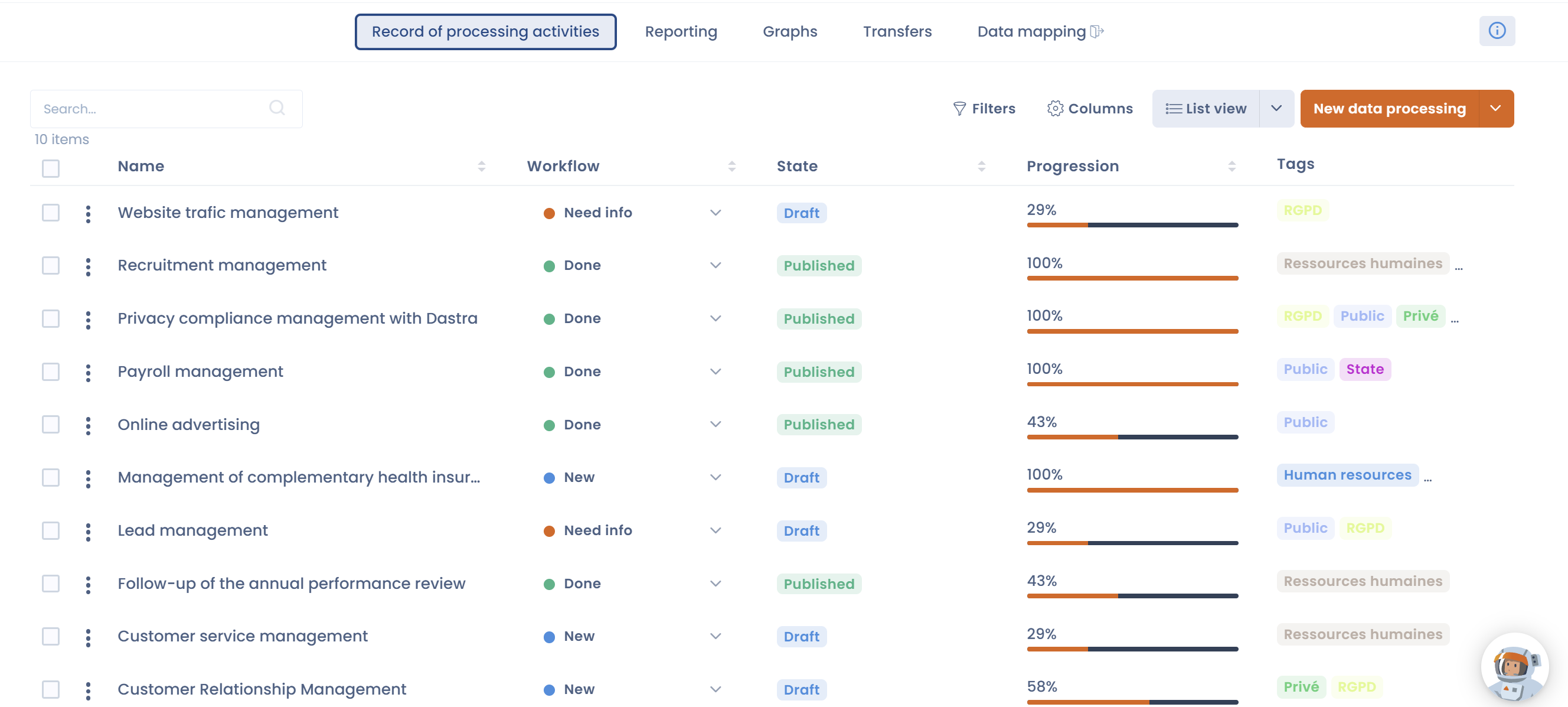
Comply with the obligation of Article 30 of the GDPR and benefit from a powerful management tool designed by GDPR experts for DPOs. Document processing activities using templates, questionnaires, or even AI to increase efficiency and finally keep them up to date!
Collaborate effectively with a set of pre-configured records designed to facilitate teamwork. Enrich your repositories and link them to your processing activities, data breaches, rights exercise requests, and files for comprehensive and centralized management.
From request submission to fulfilment, including secure identity verification, centralise and manage requests from employees, customers and partners directly within the platform. Simplify request handling while ensuring compliance, security and full traceability.
Record and track personal data breaches identified internally or reported by your processors, then assess their level of risk to ensure effective investigation, remediation and regulatory compliance.
Easily generate compliance reports and audits with one click using our document automation solution. Save time and focus on what matters! Export your record in a multitude of formats (PDF, Excel, CSV, JSON, Word, Markdown...) in just a few clicks.
Data Protection Officer (DPO)
Carry out your advisory and control mission simply and efficiently!

Data Controller (CDO)
Map the personal data of your organization

Data Protection Officer (DPO)
Align security and data protection.

Data controller
Align risk management, compliance, and data protection

External DPO
Manage all your clients’ privacy needs with the simplicity of managing just one.

General Management
Establish and effectively enhance data protection within your organization

Margreet Bruinsma, DPO
What are the prohibitions of the general data protection regulation?
The GDPR prohibits the collection and use of data revealing racial or ethnic origin, political opinions, religious or philosophical beliefs, trade union membership, as well as the processing of genetic data, biometric data allowing for the unique identification of a person, health information, or data related to an individual's sexual life or sexual orientation.
However, there are exceptions to this prohibition, including:
What are the main obligations of the GDPR?
What are the 3 principles of the GDPR?
The three main principles of the general data protection regulation are:
In which Dastra subscription plan can I benefit from the Cookie consent module?
The consent management platform is marketed as a dedicated module. Depending on the number of visitors to your website, the subscription fee will vary. See our pricing page or contact us for more information.
Is a cookie banner mandatory?
A cookie banner is essential as soon as you store or access information on a user's device, regardless of the technology used. As soon as non-essential trackers are used — such as those for targeted advertising, audience measurement with identifiable data, or personalization — you must inform the user and obtain their prior consent.
What are the 3 types of cookies?
Cookies can be classified into several categories:
What is the ePrivacy Directive?
The ePrivacy Directive 2002/58/EC, amended in 2009, often referred to as the "Privacy and Electronic Communications Directive", is an initiative of the European Commission aimed at ensuring the confidentiality of communications and protecting users against certain intrusive practices in the digital realm. It is transposed differently in each Member State (in France, through the Data Protection Act, particularly regarding cookies and direct marketing).
In which Dastra subscription plan can I benefit from the AI Act?
The AI Act is marketed in a dedicated or complementary module of the Privacy offerings. Depending on the number of employees in your company, the subscription amount will vary. Please consult our pricing page or contact us to learn more.
What are the forms of risks?
The approach to AI systems is based on a risk assessment. The regulatory framework defines four categories of risk for artificial intelligence systems (AIS), with varying levels of regulation depending on the different levels of the pyramid.
What is the purpose of the AI Act?
The AI Act aims to create a harmonized legal framework in the EU to ensure that artificial intelligence systems are safe, transparent, ethical, and respect fundamental rights. More specifically, it has the following objectives:
What is the EU regulation on AI?
The AI Act, or Regulation on Artificial Intelligence, is a regulation developed to regulate and encourage the development as well as the marketing of artificial intelligence systems within the European Union. Proposed by the European Commission in April 2021, the AI Act came into effect on July 12, 2024, after three years of negotiations.
Difference between an AI system and an AI model
Understanding the distinction between an AI model and an AI system is important for anyone interested in artificial intelligence, whether for developing new technologies or using them.
AI models are the fundamental components that perform specific tasks, while AI systems integrate these models into complete and functional solutions to address practical needs.
By recognizing these differences, one can better appreciate the complexity and scope of AI applications in various fields.
An AI model is a central component of artificial intelligence. It is a mathematical or statistical representation of a specific problem, developed from data.
AI models are trained to recognize patterns, make predictions, or make decisions based on data.
The most common types of AI models include neural networks, decision trees, support vector machines, and regression models.
Examples of AI models include:
The AI model is somewhat like the brain of AI. It is built and optimized through a training process, where it learns from historical data to improve its accuracy and efficiency.
An AI system is a broader and more complex application that integrates one or more AI models to accomplish a specific task.
It encompasses not only AI models but also the necessary components to collect, process, and analyze data, as well as interact with users.
In other words, an AI system is a complete solution that implements AI models within an operational framework.
Components of an AI system include:
Example of an AI system includes:
Scale and Complexity:
Components:
Functionality:
List your AI use cases and identify associated risks within Dastra.
How do I cancel my subscription?
In order to cancel your subscription, please contact us adding any information that can help us identify your subscription (company name, etc).
How quickly can the work environment be deployed?
The Dastra work environment is deployed immediately after the creation of the entity.
I work in a large company, is DASTRA adapted to our size?
Yes, we offer subscriptions dedicated to large structures (large and medium-sized companies) composed of several legal entities.
Dastra is particularly well suited for corporate groups, either centralized with a single location for entity management and shared repositories, or decentralized.
Please contact us if you would like to know more information on how Dastra can help your specific organization.
How long does my trial offer last?
The trial offer is for a period of one (1) month. After that, you can contact us directly to extend it if you need it.
Can I host the files in my own environment?
Yes!
With DASTRA, you can connect yourself your own data hosting solution to host the documents stored in the application. This includes all documents stored in the document management system and documents stored in the rights management system.
You have control over the security of this hosting. The files remain under your control.
Today, we can connect Amazon S3 and Azure Blob Storage. Other services can be developed on demand, please contact us if you have a question regarding this topic.
Does Dastra comply with the government's General Accessibility Guidelines for French administrations (RGAA)?
Yes, in part !
We have completed a compliance audit of the General Accessibility Guidelines for the Administration (RGAA).
Our cookie choice management widget is fully compliant with the RGAA.
We have made the necessary changes to the source code to comply with accessibility standards.
Thus, the use of the widget and its appropriate configuration will maintain compliance with the standard for the site that hosts the widget.
More information about this standard: https://www.numerique.gouv.fr/publications/rgaa-accessibilite/
What happens when my subscription expires?
When your subscription expires and without renewing your contract, you will no longer be able to access or modify the information contained in your space. The information is deleted within a reasonable time (maximum 2 months).
Is the data secure with Dastra?
We apply strict security measures to our environment, both at the application and development levels.
We maintain a technical watch and have our solution regularly audited in order to provide the maximum guarantees on the security of the data you entrust to us.
You can find out more on our page dedicated to security.
Dastra.eu is free to try, easy to set up, and work seamlessly together.
* You can unsubscribe at any time using the link provided in each newsletter.